
PART 1: IELTS WRITING TASK 1
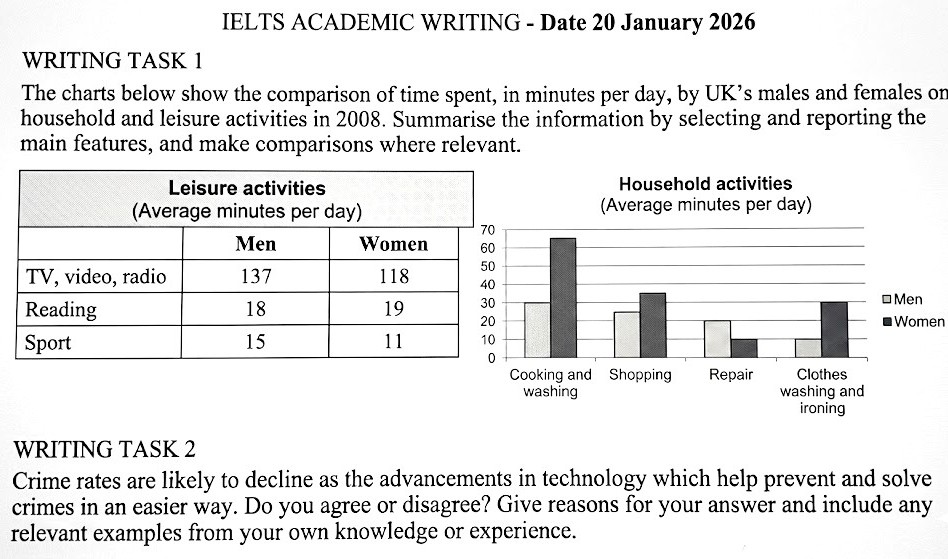
Đề bài: The charts below show the comparison of time spent, in minutes per day, by UK’s males and females on household and leisure activities in 2008.
Structure Analysis (Cấu trúc bài viết)
Một bài Task 1 chuẩn bao gồm 4 đoạn văn:
- Introduction: Paraphrase (viết lại) đề bài.
- Overview: Nêu 1-2 xu hướng chính nổi bật nhất (không nêu số liệu cụ thể ở đây).
- Body Paragraph 1: Phân tích chi tiết nhóm dữ liệu 1 (Leisure activities).
- Body Paragraph 2: Phân tích chi tiết nhóm dữ liệu 2 (Household activities).
Step-by-Step Guide & Useful Language (Hướng dẫn từng bước)
Step 1: Introduction
Goal: Viết lại đề bài bằng từ vựng khác nhưng giữ nguyên nghĩa.
- Original: “The charts below show the comparison of time spent…”
- Vocabulary needed:
- Show Illustrate / Compare / Depict
- Time spent The average amount of time allocated to… / Time dedication
- Males and females Men and women / Both genders
Mẫu câu (Template):
The table and bar chart compare the average time spent by men and women in the UK on various leisure and household activities in 2008.
Step 2: Overview (Quan trọng nhất)
Goal: Tìm ra sự tương phản lớn nhất.
- Nhìn vào biểu đồ: Nam dành nhiều thời gian giải trí hơn. Nữ làm việc nhà nhiều hơn hẳn (trừ việc sửa chữa – Repair).
- Vocabulary:
- Overall / It is clear that…
- Gender gap (khoảng cách giới tính).
- Dominant (chiếm ưu thế).
Mẫu câu (Template):
Overall, it is clear that there was a distinct gender division in time usage. While men dedicated more time to leisure activities, women bore the main responsibility for household chores, with the exception of repair work.
Step 3: Body Paragraphs (Details)
Goal: So sánh số liệu cụ thể. Sử dụng từ ngữ so sánh (comparative language).
- Body 1 (Leisure – The Table):
- TV: Cao nhất cho cả hai. Nam (137) > Nữ (118).
- Reading: Ngang nhau (18 vs 19).
- Sports: Nam > Nữ một chút.
- Useful phrases: The most popular activity, slightly higher, roughly equal.
- Body 2 (Household – The Bar Chart):
- Cooking/Washing: Nữ (khoảng 75) > Nam (30) Gấp đôi.
- Shopping & Clothes washing: Nữ > Nam.
- Repair: Nam > Nữ.
- Useful phrases: More than double, significantly more, spend time on…, whereas.
Sample Answer Task 1
The table and bar chart illustrate the average amount of time spent by men and women in the UK on different leisure and household activities in 2008.
Overall, it is evident that there was a significant imbalance in how the two genders utilized their time. Men spent more time on entertainment and sports, whereas women dedicated considerably more time to domestic duties, except for home repairs.
Regarding leisure activities, watching TV, video, and radio was the dominant pastime for both genders, though men spent approximately 137 minutes per day on this, compared to 118 minutes for women. In contrast, time spent on reading was nearly identical, with women reading slightly more (19 minutes) than men (18 minutes). Participation in sports was low for both, although men were slightly more active, averaging 15 minutes daily versus 11 minutes for women.
Turning to household chores, women performed the majority of the work. The disparity was most striking in cooking and washing, where women spent roughly 75 minutes per day, more than double the figure for men (30 minutes). Similarly, women spent more time on shopping (35 minutes) and clothes washing (30 minutes) compared to men’s 25 and 10 minutes, respectively. The only exception was repair work, which occupied nearly 20 minutes of men’s day, while women spent less than 10 minutes on this task.
(198 words)
PART 2: IELTS WRITING TASK 2 (Essay)
Đề bài: Crime rates are likely to decline as the advancements in technology which help prevent and solve crimes in an easier way. Do you agree or disagree?
Structure Analysis (Cấu trúc bài viết)
Dạng bài Agree or Disagree. Cách dễ nhất là chọn Strongly Agree (Hoàn toàn đồng ý) để lập luận sắc bén.
- Introduction: Hook + Paraphrase topic + Thesis statement (I agree).
- Body Paragraph 1 (Prevention): Công nghệ giúp ngăn chặn tội phạm (Camera, báo động).
- Body Paragraph 2 (Solution): Công nghệ giúp phá án (DNA, dấu vết điện tử).
- Conclusion: Khẳng định lại quan điểm.
Step-by-Step Guide & Useful Language
Step 1: Introduction
Goal: Giới thiệu chủ đề và đưa ra quan điểm.
- Vocabulary:
- Advancements in technology Technological breakthroughs / The digital era.
- Prevent and solve Deterrence and investigation.
- Decline Reduction / Decrease.
Mẫu câu (Template):
It is often argued that modern technology will lead to a drop in crime rates. I completely agree with this viewpoint because technology acts as a powerful deterrent and provides precise tools for investigation.
Step 2: Body Paragraph 1 – Prevention
Idea: Tại sao công nghệ làm tội phạm sợ?
- Keyword: Surveillance (Giám sát), CCTV, Facial recognition (Nhận diện khuôn mặt).
- Logic: Nếu biết mình bị quay phim, tội phạm sẽ không dám hành động.
- Useful phrases: Act as a deterrent (đóng vai trò răn đe), discourage criminals (làm nản lòng tội phạm).
Step 3: Body Paragraph 2 – Solving Crimes
Idea: Khi tội ác đã xảy ra, công nghệ giúp bắt thủ phạm thế nào?
- Keyword: Forensic science (Khoa học pháp y), DNA profiling, Digital footprint (Dấu vết số – GPS, tin nhắn).
- Logic: Trước đây dựa vào nhân chứng (không chính xác), giờ dựa vào khoa học (chính xác tuyệt đối).
Step 4: Conclusion
Goal: Tóm tắt lại. Mẫu câu:
In conclusion, I firmly believe that…
Sample Answer Task 2
The rapid evolution of technology has revolutionized law enforcement and public safety. Many people believe that these advancements will significantly reduce crime rates by simplifying both prevention and detection. I strongly agree with this perspective, as technology serves as both a formidable deterrent and a critical tool for solving investigations.
Firstly, advanced surveillance technology acts as a powerful deterrent, preventing crimes before they occur. The widespread installation of CCTV cameras equipped with facial recognition software has made it increasingly difficult for offenders to remain anonymous in public spaces. For example, in major cities like London, the extensive network of cameras discourages opportunistic crimes such as pickpocketing or vandalism because criminals know there is a high probability of being watched. Furthermore, sophisticated home security systems, including smart alarms and motion sensors, have made residential burglary far riskier, thereby reducing its frequency.
Secondly, technology has dramatically improved the efficiency and accuracy of criminal investigations. In the past, police often relied on unreliable eyewitness testimonies. Today, forensic science, such as DNA profiling, allows authorities to identify suspects with near-perfect certainty from minute traces left at a crime scene. Additionally, the digital footprint left by individuals—through mobile phone GPS, credit card transactions, and social media activity—provides investigators with an irrefutable trail of evidence. This high likelihood of being caught and convicted eventually leads to a decline in crime rates.
In conclusion, I firmly believe that technological progress is a key factor in making society safer. By increasing the risk of detection through surveillance and providing scientific evidence for prosecution, technology empowers law enforcement to effectively reduce crime.
(268 words)